


.avif)

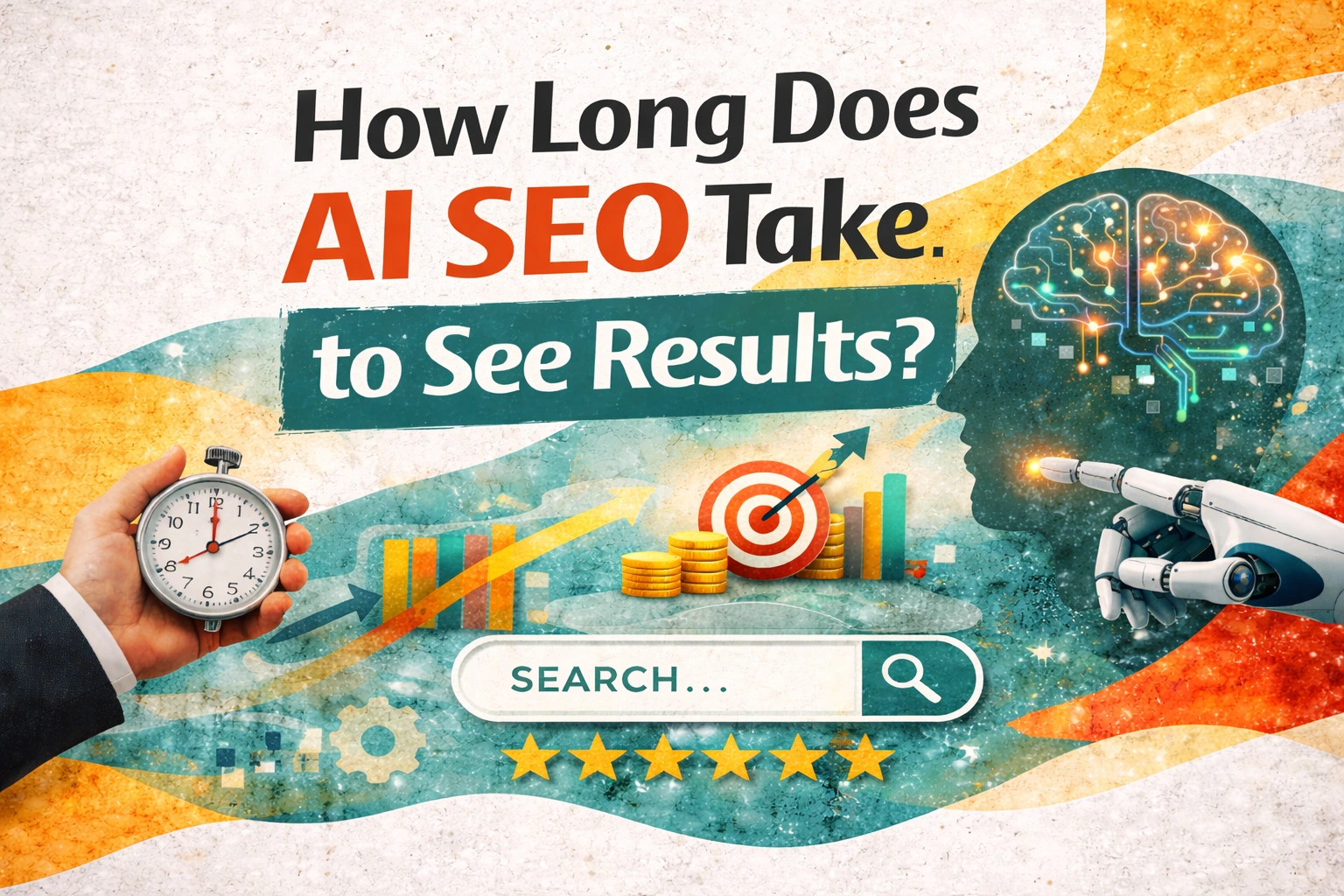
Artificial intelligence search systems have changed how visibility is earned and how progress is measured. Traditional SEO relied on ranking improvements, link acquisition cycles, and content indexing timelines. AI SEO, also known as artificial intelligence search engine optimisation, involves optimisation for systems such as Google AI Mode, ChatGPT Search, Perplexity, Claude, and Bing Copilot. These environments evaluate clarity, credibility, entity strength, and factual alignment rather than only keyword placement.
Many businesses are now asking how long it takes to see results from AI SEO. The answer depends on how well a website supports interpretability, authority signals, and machine-readable structure rather than only technical and on-page optimisation. Timelines remain important, but the mechanisms behind progress are different.
AI-driven search environments do not wait for ranking shifts to begin influencing visibility. They surface information based on retrieval confidence, factual reliability, and entity consistency. This means results can appear sooner in some areas and later in others compared with traditional SEO.
Enhance your visibility across AI-powered search systems with our AI SEO optimisation service.
Why AI SEO Works on Different Timelines Than Traditional SEO
Traditional SEO timelines were shaped by:
- Indexing patterns
- Ranking calculations
- Link velocity
- Domain age
- Competitive landscape
AI SEO performance is shaped by:
- How quickly can AI systems interpret the content
- How strong and consistent the entity signals are
- Whether information can be summarised without ambiguity
- How pages align with common reasoning patterns
- Whether the brand has demonstrable authority
- Structures that support retrieval across multiple LLMs
These systems operate on reasoning and evaluation rather than ranking and indexing. This creates a different timeline profile.
Some improvements can be visible quickly. Others require structural reinforcement and authority growth.
What AI SEO Improves Faster Than Traditional SEO
AI systems reward clarity and structure. When these are improved, results can appear quickly within:
- ChatGPT Search recommendations
- Perplexity citations
- Claude sourced summaries
- Google AI Mode short-form answers
- Entity-level recognition across LLMs
These improvements happen when the model gains enough confidence to use the content as a reference. This does not require traditional ranking changes.
Even minor changes to clarity and structure can improve:
- Response inclusion
- Citation likelihood
- Summarisation visibility
- Multi-source comparisons
These gains can occur within weeks.
Book a strategy consultation to understand how artificial intelligence search behaviour affects your website and long-term visibility.
What Takes Longer in AI SEO
Some areas still require more time:
- Establishing authority signals
- Strengthening entity recognition
- Consistent third-party validation
- Accumulating factual trust
- Reinforcing brand reputation across the web
AI systems lean heavily on reputation and stability. These patterns take longer to influence.
Authority growth behaves similarly to traditional SEO, but with more emphasis on credibility signals rather than link volume alone.
Timeline Factors Unique to AI Search
AI SEO timelines depend on several modern variables that traditional SEO did not rely on.
Key factors include:
- Entity consistency across content clusters
- Accuracy and factual grounding
- Demonstrated expertise
- How well does the information fit the reasoning patterns
- Schema and semantic structure
- Clarity of definitions and terminology
- Volume of contradictory or vague information
- Whether the brand aligns with known facts in external sources
These factors determine how quickly a model will trust a page enough to include it in reasoning-based answers.
AI SEO Timeline Overview
Different tasks within AI SEO generate results at different speeds. Some improvements influence retrieval and reasoning almost immediately, while bigger authority-based changes require longer cycles. Observed behaviour across Google AI Mode, Perplexity, ChatGPT Search, and Claude indicates that timelines depend on which signals the optimisation targets.
The following table outlines typical timeframe ranges for AI SEO outcomes based on tests, public documentation, and the behaviour of large language models in content retrieval and evaluation.
Scenario-Based AI SEO Timelines
AI SEO timelines vary depending on the starting point of the website and the level of authority, clarity, and entity consistency already present. The following scenarios show how different types of websites may experience progress across AI-powered search systems.
New Websites
New websites typically require more time to establish authority signals. AI systems rely on patterns such as domain history, content reliability, and external validation when determining whether information can be trusted. Improvements in clarity and structure may generate early movement, but broader visibility across multiple LLMs generally takes longer.
Established Websites With Weak Content Structure
Websites with existing authority but unclear content structure often see improvements sooner. When content becomes easier for models to interpret, AI systems increase retrieval confidence. This can lead to faster inclusion in short-form answers, summaries, and comparison sections.
Strong Websites With Existing Expertise
Websites that already publish reliable, structured content and have established entity presence tend to see the fastest improvements. Semantic enhancements, schema updates, and clarification of definitions often produce noticeable progress across LLM-driven environments within weeks.
Why Some AI SEO Improvements Appear Faster
AI systems interpret content based on clarity and reasoning rather than only ranking patterns. When content is structured more logically, or definitions are clarified, the model can analyse and reuse that information without needing extended indexing cycles.
Fast-moving areas include:
- Clarifying terminology
- Improving formatting
- Reducing ambiguity
- Applying schema
- Updating factual information
- Adding structured comparisons
- Aligning content with user intent
These tasks influence retrieval directly. When the model recognises improved interpretability, it updates internal confidence more quickly than traditional ranking systems.
What Slows Down AI SEO Performance
Some areas contain longer development cycles and slower impact windows. These delays occur when authority, trust, or external confirmation needs to accumulate before AI systems will reference a source.
Slower-moving elements include:
- Weak entity alignment
- Inconsistent naming
- Outdated claims
- Limited external validation
- Thin content across key topics
- Lack of authorship clarity
- Gaps in expertise signals
These require sustained improvements and may take several months before AI systems recognise the brand as a reliable reference.
Timelines Across Different AI Systems
AI systems generate results using different retrieval and reasoning methods. Some lean heavily on structured data, others prioritise stable entities, and some rely on verified citations. Because of these differences, timelines for visibility can vary across platforms.
The following table summarises typical timeline patterns observed across major AI search environments based on model behaviour, documentation, and practical optimisation outcomes.
How Long Until AI Systems Trust a Brand?
Artificial intelligence systems rely on historical patterns, conceptual consistency, and factual reliability. Trust accumulates over time as information remains stable and aligns with established knowledge.
Timelines vary depending on the starting state:
- Brands with existing authority may build trust within months
- New brands may require longer periods for consistency patterns to form
- Erratic or contradictory content resets trust signals
- Frequent updates without clarity can confuse entity alignment
Trust is a cumulative process rather than a single improvement.
How to Accelerate AI SEO Results
Results appear faster when AI systems can interpret information with high confidence. Acceleration comes from improving clarity, removing ambiguity, and strengthening entity-level consistency. These adjustments help models understand how content should be used in reasoning-based outputs.
Areas that influence faster movement include:
- Clear definitions at the beginning of pages
- Reduction of duplicate or conflicting statements
- Improved logical sequencing across content clusters
- Structured data reinforcing organisational identity
- Consolidation of fragmented pages into unified resources
- Addition of experience-driven examples or factual grounding
These changes support retrieval confidence. When an AI system can match user intent to a content segment precisely, results appear more quickly across multiple environments.
Realistic Expectations for AI SEO Timelines
Artificial intelligence search engine optimisation requires both short-term optimisations and long-term authority development. Some changes produce observable improvements rapidly, while others depend on accumulating trust over time.
Short-term expectations:
- Improved clarity and structure can influence AI responses within weeks
- Enhanced schema and semantic consistency can improve retrieval confidence
- Clean comparison or definition-based pages may be reused sooner in generative answers
Long-term expectations:
- Building consistent authority takes several months
- Strengthening external validation requires ongoing effort
- Entity consolidation across the web occurs gradually
- Brand reputation effects take time to stabilise
Progress happens across multiple surfaces, not only in rankings. Early signs of improvement often appear in AI summaries, product comparisons, and conversational retrieval systems before organic visibility shifts.
How AI SEO Performance Should Be Measured
AI SEO introduces new metrics that complement traditional ones. Measurement should reflect how information is being discovered, referenced, and reused across multiple large language model systems.
Relevant indicators include:
- Inclusion in generative summaries
- Appearance in reasoning-based answers
- Citation frequency across Perplexity
- Response visibility in ChatGPT Search
- Entity recognition stability
- Consistency across topic clusters
- Improvements in structured data interpretation
These signals provide a clearer picture of progress than ranking movement alone.
AI SEO Readiness Framework
A readiness framework helps determine how prepared a website is for artificial intelligence-driven search environments. It identifies structural, semantic, and authority-based elements that influence how quickly improvements become visible.
The table below summarises the primary readiness factors that affect AI SEO timelines based on observed behaviour across ChatGPT Search, Google AI Mode, Claude, Perplexity, and Bing Copilot.
Request an AI search readiness audit to identify performance gaps, structural issues, and optimisation opportunities.
FAQs
How long does AI SEO take to show results?
Some improvements appear within weeks, especially those related to clarity and structured formatting. Authority-based gains generally take several months.
Is AI SEO faster than traditional SEO?
In certain areas, yes. AI systems adjust retrieval confidence more quickly than search engines adjust rankings, but authority development still requires time.
Can AI SEO improvements appear before ranking changes?
Yes. Inclusion in generative answers and reasoning-based outputs often appears earlier than traditional organic movement.
Do all AI systems respond at the same speed?
No. ChatGPT and Bing Copilot tend to adjust faster, while Perplexity and Claude prioritise evidence and may require longer validation periods.
Does link building affect AI SEO timelines?
Link signals contribute to authority and trust, but clarity, consistency, and semantic strength often have a faster impact.
Conclusion
AI SEO timelines reflect how artificial intelligence systems interpret, evaluate, and trust information. Some improvements influence visibility quickly, while others develop gradually as authority and consistency strengthen. Understanding these patterns helps set realistic expectations and guides the work required to achieve multi-model search visibility.
Related blog posts

AI Search and Seasonal Trends: How to Win Peak Moments
Why AI search engines treat seasonal trends differently from Google, why last-minute SEO no longer works for peak moments, and the modern 12-month playbook for winning AI search visibility around Black Friday, Christmas and other UK seasonal events.
How to Rank, Optimise and Win on Perplexity AI in 2026
A definitive 2026 playbook for Perplexity AI - how it works, what it rewards, and the exact strategy to earn AI citations and visibility.
The 12 Best UK AI SEO Agencies for 2026
The 12 best UK AI SEO agencies for 2026 - explore the new search landscape, practical AI SEO strategies, and why Appear Online leads the future.

ChatGPT Prompts for SEO and Marketing Teams - The 2026 Strategic Guide
The 2026 strategic guide to ChatGPT prompts for SEO and marketing teams. Covers the anatomy of a good prompt, workflow-organised prompt frameworks for SEO, content, digital PR, local SEO and reporting, advanced techniques, common mistakes and how to integrate ChatGPT into your marketing workflow.
Author Pages and AI Trust - Why Blogs Need Clear Human Signals
A practical guide to author pages, why they matter for AI trust, and how clear authorship improves blog visibility and credibility.

AI Search Optimisation Checklist 2026
AI search is changing how users find businesses. This checklist shows how to optimise for ChatGPT, Google AI, and Perplexity in 2026.
Get a FREE Website Audit
Dominate search results and attract more qualified traffic. Our free search performance audit will analyse your website's visibility across all major search engines and provide actionable insights to improve your online presence.

