


.avif)
Full-Funnel SEO - The 2026 UK Guide

Introduction
Most SEO programmes fail not because the execution is poor but because the strategy only covers part of the funnel. Content marketing teams focus on the top of funnel (educational content, keyword research, editorial coverage), conversion teams focus on the bottom (product pages, conversion rate optimisation, transactional keywords), and the middle usually gets treated as an afterthought. The result is programmes that produce impressive traffic reports but weak revenue attribution, or strong direct response performance with no defensible brand share of voice. Full-funnel SEO fixes this by treating awareness, consideration, decision and retention as a single system rather than four separate disciplines.
The importance of this integrated approach has grown materially since 2023. AI search platforms have changed how buyers move through the funnel entirely (research and comparison stages that used to happen across multiple sessions now often happen in a single ChatGPT conversation), zero-click search has intensified across every stage, brand and demand generation now compound in ways that were less measurable five years ago, and the buyer journey for both B2B and considered B2C purchases has become non-linear enough that thinking in "funnel stages" as fixed states no longer works. Full-funnel SEO in 2026 requires understanding how buyers actually flow (and loop back) through the modern search environment.
This guide sets out how full-funnel SEO works in 2026, the four main funnel stages and what SEO delivery looks like at each, how AI search has changed movement between stages, the metrics that matter at each stage of the funnel, common integration failures we see in UK programmes, and how to structure a full-funnel programme rather than a stack of siloed activities. It is written for SEO leads, growth teams and marketing directors at UK brands treating SEO as a revenue capability rather than a traffic function.
What Is Full-Funnel SEO?
Full-funnel SEO is the integrated practice of building organic search visibility across every stage of the buyer journey, from initial awareness through consideration and decision to post-purchase retention. It treats the funnel as a system where each stage feeds and reinforces the next, rather than as a set of discrete campaigns.
In practice, this means running SEO activity that captures buyers early (educational content, category-defining thought leadership, brand-building digital PR), guides them through comparison and evaluation (comparison content, expert authority signals, review platform strategy, AI shortlist visibility), converts them at the point of decision (transactional content, product and service page optimisation, structured data, conversion rate optimisation) and retains them post-purchase (help content, customer education, community-building, retention-oriented SEO). The programme is measured against revenue outcomes rather than stage-specific traffic metrics. The underlying marketing funnel framework shapes the strategy at every stage, but full-funnel SEO applies it as one integrated system rather than four disconnected campaigns.
The critical distinction: full-funnel SEO is not just doing more SEO. It is designing SEO activity so each stage compounds the effect of the others. A well-optimised product page performs materially better when supported by strong category authority; a category thought leadership programme drives more revenue when it feeds into a well-designed decision-stage journey; a retention SEO programme lowers customer acquisition cost across the whole funnel by increasing lifetime value. The integration is where the value is.
Why Full-Funnel SEO Matters More in 2026
Four shifts have raised the importance of integrated funnel thinking since 2023.
First, AI search has changed how buyers move through the funnel. Where a traditional buyer journey involved multiple sessions across weeks (awareness search, comparison search, decision search), AI conversations now compress these into single sessions. A buyer asking ChatGPT "what should I look for in a UK payroll platform" and then "compare Xero vs QuickBooks payroll for a UK small business" and then "is [Brand] a good option for UK small businesses" has completed the top, middle and evaluation stages of the funnel in a single conversation. Brands without integrated coverage across all three stages get eliminated silently.
Second, zero-click search has intensified across every stage. Google AI Overviews and featured snippets satisfy an increasing share of informational queries directly in the SERP, meaning traditional top-of-funnel traffic no longer flows to publishers the way it did. This has raised the importance of brand and category authority (so buyers remember your brand from the SERP even when they do not click) and lower-funnel visibility (because the buyers who do click through are more decision-ready than they used to be).
Third, brand search and demand generation have become more measurable. Where it used to be difficult to attribute brand awareness activity to revenue, better modelling and cleaner attribution tools now let SEO teams demonstrate how top-of-funnel authority building drives increases in branded search volume, direct traffic and eventually lower-funnel conversions. The brands doing this well have earned the case for full-funnel investment; the brands that ignore attribution still struggle to justify top-of-funnel work internally.
Fourth, the buyer journey has become fundamentally non-linear. Modern buyers loop back and forth between stages, restart their research months later, discover new categories mid-journey, and switch between search engines and AI tools freely. Programmes designed for a linear awareness-consideration-decision funnel no longer match how people actually buy. Full-funnel SEO in 2026 has to work as a network of interconnected content and authority signals rather than as a linear path.
The Four Funnel Stages and What SEO Looks Like at Each
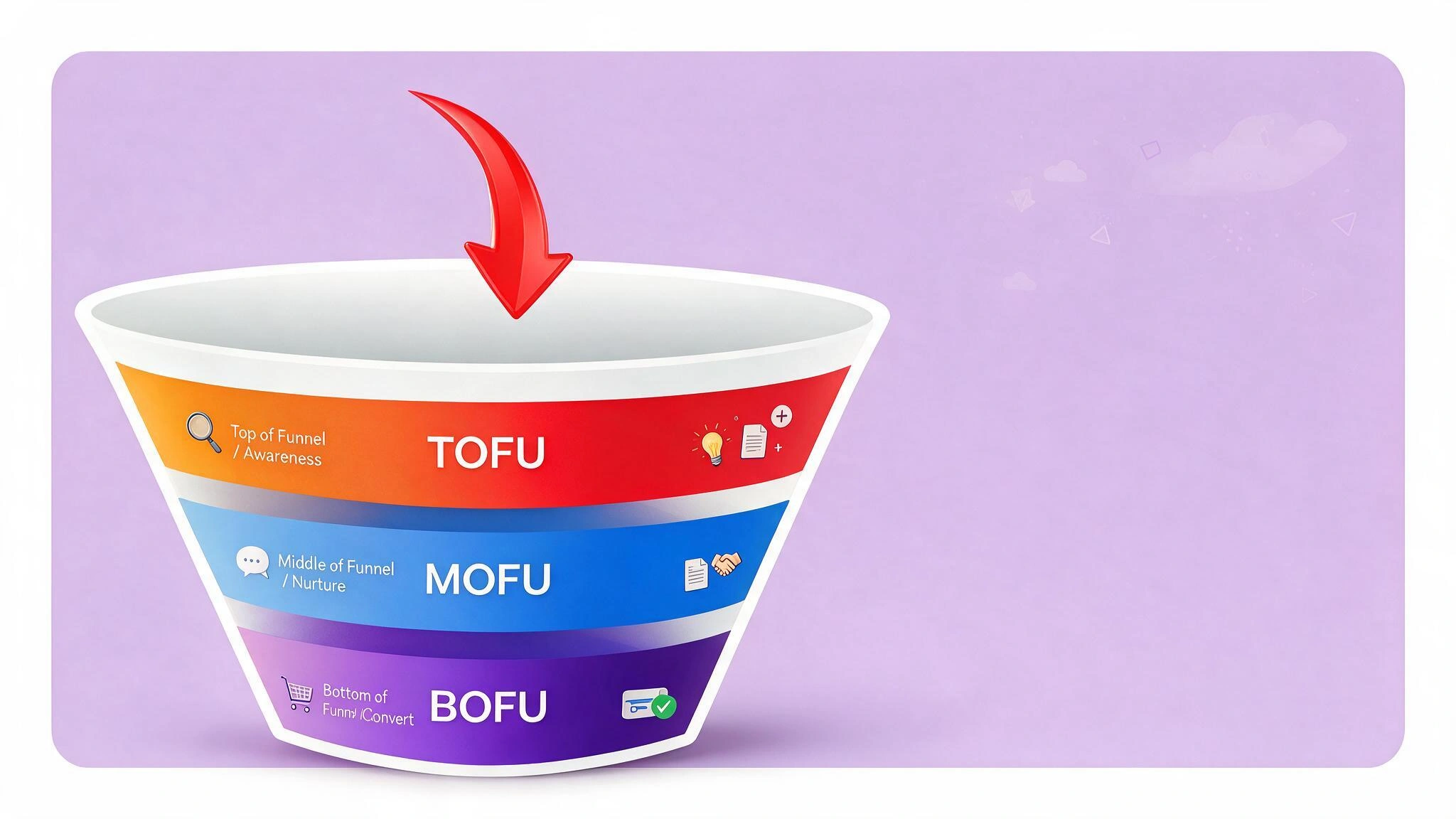
The classic four-stage funnel (awareness, consideration, decision, retention) still provides a useful working framework, provided we treat the stages as interconnected rather than sequential. The table below summarises what SEO activity looks like at each stage.
Each stage requires different content types, different keyword targeting logic, different success metrics and different link-building strategies. The mistake most programmes make is designing for one or two stages and treating the others as by-products. The programmes that win in 2026 design deliberately for all four.
Awareness Stage SEO: Building Category Authority
The awareness stage is where brands earn the right to be considered. Buyers at this stage are researching problems, defining categories and forming mental shortlists that they will later compare against. SEO activity here should focus on building durable category authority that compounds over time.
The core activities: category-defining educational content (in-depth guides, definitional articles, category explainers), thought leadership on emerging trends, tier-one digital PR and editorial coverage that positions the brand as a category authority, expert content from named authors with verifiable credentials, and AI search visibility for informational queries where AI systems generate direct answers rather than pointing to specific brands.
The keyword targeting logic at this stage is intent-first rather than volume-first. High-volume informational keywords ("what is X", "how does Y work") often produce zero-click results in 2026, but they are still worth targeting because the brand associations built at this stage compound into branded search volume and eventual decision-stage conversions. Category-defining keywords ("[category] guide", "[category] best practices", "[category] framework") are particularly valuable because they position the brand as a category authority rather than just a vendor.
The metrics that matter at this stage are share of voice against category competitors, growth in branded search volume over 6 to 12 months, referring domain growth from category-relevant publications, and visibility in AI search shortlists for informational category queries. Traffic and rankings on individual awareness-stage keywords matter less than aggregate authority signals across the category.
The most common failure at this stage is treating awareness content as SEO-first rather than authority-first. Content designed only to rank tends to be generic and easily replaced by AI-generated equivalents. Content designed to establish authority (with named experts, original perspectives, primary research and genuine insight) produces both rankings and the compounding brand associations that drive later-stage revenue. The specific weightings AI systems apply to editorial authority signals are covered in our guide to E-E-A-T and brand authority in AI search.
Consideration Stage SEO: Winning the Shortlist
The consideration stage is where buyers narrow their options and build shortlists. In 2026, this stage is materially different from 2023 because a substantial share of consideration research now happens through AI conversations rather than traditional Google searches, and because listicle inclusion has become one of the primary AI shortlist signals.
The core activities at this stage: comparison content that addresses head-to-head decisions ("X vs Y", "alternatives to Z", "best UK [category]"), listicle inclusion work that earns placements in "best of" articles across trade press and consumer media, review platform strategy that ensures depth of reviews on Trustpilot, Google, Doctify, G2, Capterra and category-specific platforms, expert authority signals through bylines and thought leadership, and structured content that AI systems can cite when generating shortlist recommendations.
The keyword targeting logic at this stage is commercial investigation intent. Buyers using queries like "best UK [category]", "[category] compared", "[Brand A] vs [Brand B]", "alternatives to [competitor]" are actively building shortlists and evaluating options. Content that appears here directly influences purchase decisions in a way that awareness-stage traffic rarely does.
The metrics that matter at this stage are share of voice on commercial-investigation queries, listicle placements secured over rolling six-month periods, appearance in AI search shortlists for category queries, review platform depth and freshness relative to competitors, and progression from consideration-stage traffic into decision-stage journeys.
Broader coverage of how tier-one placements support consideration-stage SEO is in our guide to tier-one digital PR placements.
Decision Stage SEO: Converting High-Intent Buyers
The decision stage is where buyers commit. SEO activity here should focus on making the conversion path as frictionless as possible for buyers who have already done their research and are validating a final choice.
The core activities: product and service page optimisation for high-intent transactional keywords, structured data (Product, Review, FAQ, LocalBusiness, Service schema) that supports rich results and AI citation, testimonial and case study content that reassures decision-ready buyers, local SEO signals for location-relevant purchases, conversion rate optimisation, and internal linking that guides shortlist visitors to specific product or service pages.
The keyword targeting logic at this stage is transactional intent. Buyers using queries like "[product] price", "buy [product] UK", "book [service]", "[brand] pricing", "[service] near me" are ready to convert and need friction removed rather than more information. Content that appears here directly drives revenue, and the conversion economics are usually meaningfully better than at earlier stages.
The metrics that matter at this stage are conversion rate from organic traffic, revenue attributed to organic decision-stage keywords, click-through rate from rich results and AI citations, and the ratio of assisted conversions from earlier stages to direct conversions from decision-stage traffic. This last metric matters because it reveals whether awareness and consideration activity is genuinely feeding decision-stage conversions or running in parallel.
Broader coverage of how structured data supports decision-stage visibility (both traditional and AI search) is in our guide to schema markup for SEO and AI search.
Retention Stage SEO: Compounding Lifetime Value
The retention stage is the most underinvested part of most SEO programmes and often has the highest ROI when properly funded. Existing customers cost less to serve, buy more over time, refer other customers and produce the review content that supports lower-funnel conversion at every other stage.
The core activities at this stage: help content and knowledge base optimisation that supports existing customer needs, customer education content that increases product usage and reduces support burden, community-building content that positions the brand as ongoing category authority, upsell and cross-sell content that surfaces adjacent product opportunities, and retention SEO that captures existing customers searching for support or expansion queries related to your product.
The keyword targeting logic at this stage is customer-intent focused. Existing customers searching for "how to do X with [product]", "[product] troubleshooting", "[product] advanced features" or "[product] integrations" are already customers, and their searches represent retention risk if the content is not there, or expansion opportunity if it is. Content that appears here reduces churn and increases lifetime value in ways that direct-response SEO metrics rarely capture.
The metrics that matter at this stage are customer support ticket deflection through content, feature adoption rate correlated with content consumption, retention and lifetime value uplift from customers who engage with content post-purchase, and reduction in customer acquisition cost driven by content-supported referrals and reviews.
How AI Search Has Changed the Funnel
AI search platforms have restructured funnel dynamics in ways that make integrated thinking more important than segmented specialism. The table below summarises the main shifts and their implications.
The combined effect is that isolated stage-specific SEO programmes increasingly leave value on the table because the AI search environment rewards brands whose signals compound across the funnel rather than concentrating in one place. Broader coverage of how AI ranking systems weight these signals is in our guide to AI ranking signals.
Metrics That Matter at Each Funnel Stage
Full-funnel SEO requires a different measurement model to segmented programmes. The table below sets out the metrics that matter at each stage and how they connect to revenue.
The cross-funnel metrics are the ones most likely to reveal whether the programme is genuinely integrated. High assisted conversion ratios from awareness and consideration activity into decision-stage revenue indicate a properly-connected funnel. Weak assisted conversion ratios indicate isolated activities running in parallel rather than a compounding system.
Common Integration Failures in Full-Funnel SEO
Recurring patterns of underperformance in UK full-funnel SEO programmes come from integration failures rather than individual-stage weaknesses. The table below summarises the most common failures and the better approach.
How to Structure a Full-Funnel SEO Programme
A properly structured full-funnel programme typically has three horizontal capabilities running across the four vertical funnel stages. The table below sets out the structure.
The horizontal capabilities feed all four stages simultaneously. A programme that runs one content strategy across awareness, consideration, decision and retention (with stage-appropriate execution at each) produces better results than four separate content programmes. The same logic applies to technical foundations and authority building.
The most successful UK programmes we see have three characteristics in common. First, single strategic ownership: one senior person owns the full-funnel plan, even when execution is delegated. Second, shared measurement: cross-funnel metrics reported alongside stage-specific metrics so the interconnections are visible. Third, integrated planning cycles: awareness, consideration, decision and retention activities planned together in quarterly cycles rather than by discipline.
Broader coverage of the underlying SEO economics that support this integrated approach is in our guide to SEO return on investment.
How Appear Online Approaches Full-Funnel SEO
At Appear Online, we build integrated full-funnel programmes rather than stage-specific SEO campaigns. That typically means senior strategic ownership of the whole funnel, coordinated planning across link building, digital PR, technical SEO and content, and reporting that shows both stage-specific and cross-funnel outcomes. Our AI SEO work is integrated into the funnel strategy from the start rather than bolted on as a separate GEO project, because AI search visibility now touches every stage simultaneously.
For clients running mature marketing operations, we act as the SEO capability layer that connects existing content, sales and customer success work into a coordinated organic search programme. For clients earlier in their SEO investment, we help design the funnel structure from the start so that awareness authority, consideration visibility, decision conversion and retention support are planned as a system rather than added incrementally.
Appear Online's digital PR work regularly earns clients tier-one editorial placements in UK national and regional publications, including expert commentary in Yahoo Style UK and Wales Online, and we integrate that editorial authority into decision-stage conversion pathways rather than treating PR as a standalone brand activity. We were recognised at the Cardiff Business Awards 2024 and continue to build category authority across competitive UK B2B and consumer sectors.
Frequently Asked Questions
What is full-funnel SEO?
Full-funnel SEO is the integrated practice of building organic search visibility across every stage of the buyer journey, from awareness through consideration and decision to retention. It treats the four stages as a compounding system rather than as separate campaigns, with shared strategy, coordinated execution and cross-funnel measurement.
How is full-funnel SEO different from content marketing?
Content marketing typically focuses on the awareness and consideration stages of the funnel, and often measures success in traffic and engagement. Full-funnel SEO covers content but also technical foundations, authority building, decision-stage conversion optimisation and retention SEO, with measurement tied to revenue rather than traffic. Content marketing is often a subset of full-funnel SEO rather than a separate discipline.
Why is full-funnel SEO more important in 2026?
Three reasons. First, AI search has compressed the buyer journey so brands need visibility across every stage simultaneously. Second, zero-click search has intensified so brand and category authority now compound in ways they did not before. Third, non-linear buyer journeys mean segmented programmes leave value on the table. Broader coverage of how entities and structured signals feed AI shortlists is in our guide to entity SEO optimisation.
How long does full-funnel SEO take to work?
Different stages compound on different timelines. Decision-stage improvements (product page optimisation, structured data, local SEO) often show within three to six months. Consideration-stage work (listicle inclusion, review platform depth, comparison content) typically takes six to 12 months. Awareness-stage authority building compounds over 12 to 24 months. Retention SEO produces gradual lifetime value uplift over similar horizons. Full-programme results generally appear within nine to 18 months. Broader timeline detail is in our guide to how long SEO takes to work.
How much does full-funnel SEO cost?
Costs scale with brand size, competitive intensity and ambition. Mid-market UK businesses typically invest £4,000 to £10,000 a month for integrated full-funnel programmes covering all four stages. Enterprise programmes typically start at £10,000 to £25,000 a month. Cost is usually justified by the compound effect of integrated activity versus running four separate SEO functions at lower cost. Broader benchmarks are in our guide to SEO agency pricing.
Should full-funnel SEO be owned by SEO, marketing or growth?
Ideally, one senior person with a full-funnel remit owns the strategy, whether that person sits in SEO, growth, marketing or with an agency partner. Fragmented ownership across content, brand and demand generation teams is the single most common structural failure. Execution can be delegated widely; strategy needs a single owner.
How do I measure whether my full-funnel programme is working?
Track cross-funnel metrics alongside stage-specific metrics. The critical cross-funnel metric is assisted conversion ratio: the share of your organic revenue that involved multiple touchpoints across the funnel. High assisted conversion ratios indicate integration is working; low ratios indicate isolated activities running in parallel. Blended customer acquisition cost, lifetime value from organic and brand-branded search growth are also useful cross-funnel indicators.
Does full-funnel SEO work for small businesses?
Yes, but with proportionally lighter investment at each stage. Small businesses can run credible full-funnel programmes at £2,000 to £4,000 a month with careful prioritisation. The key is integration rather than scale: even a modest programme that treats awareness, consideration, decision and retention as connected produces better results than a small programme focused on only one stage.
How does AI search change full-funnel SEO?
AI search compresses the funnel (single conversations now often span multiple stages), rewards editorial authority (which supports both awareness and shortlist inclusion) and cites structured content (which supports both consideration and decision stages). The overall effect is that AI search rewards brands whose signals compound across the funnel rather than concentrating in one place, making integrated thinking more important than segmented specialism.
What is the highest-ROI stage to invest in first?
Depends on your current position. Brands with weak decision-stage conversion should typically start there because it is the fastest to move. Brands with strong product pages but weak awareness visibility should invest in category authority building. Brands with strong overall SEO but weak retention should invest in customer-facing content. The right first move is diagnostic-led rather than universal.
How does retention SEO fit into a full-funnel programme?
Retention SEO reduces customer acquisition cost across the whole funnel by increasing lifetime value from existing customers and generating the review, testimonial and referral content that supports every other stage. It is the most underinvested part of most UK SEO programmes and typically the one with the highest hidden ROI when properly resourced.
Can we run full-funnel SEO in-house without an agency?
Yes, if you have the capabilities and capacity. Most in-house SEO teams cover content and technical foundations well but lack tier-one digital PR relationships and dedicated authority-building capacity. The most successful UK setups we see are one senior in-house lead owning full-funnel strategy, working with a specialist agency for authority building and execution capacity. Broader coverage of the technical SEO foundations that support AI search visibility applies to in-house teams and agencies equally.
If you want help designing or auditing a full-funnel SEO programme covering awareness, consideration, decision and retention as an integrated system, you can book a consultation or request a website audit.
References:
https://cardiffbusinessawards.com/award/2024-2/
https://search.google/intl/en-GB/ways-to-search/ai-overviews/
https://uk.style.yahoo.com/sorry-white-vinegar-pest-experts-060000210.html
https://www.walesonline.co.uk/news/homes-property/experts-best-natural-pest-deterrents-33798901
Related blog posts

Mastering Lead Generation in 2026 - Tools, AI Strategies & Industry Tactics
Discover the best lead generation tools for your business. Learn how to capture, qualify, and nurture leads for sustainable growth.

How Solicitors Get Clients from Google
Learn how solicitors can attract more clients from Google through SEO. This guide breaks down the key ranking factors, local search strategies, and real-world results.
Get a FREE Website Audit
Dominate search results and attract more qualified traffic. Our free search performance audit will analyse your website's visibility across all major search engines and provide actionable insights to improve your online presence.

